What's Really in Your Water?
Water is one of the most important things we put into our bodies every day. Yet most of us rarely stop to think about what's actually in the water we're drinking.
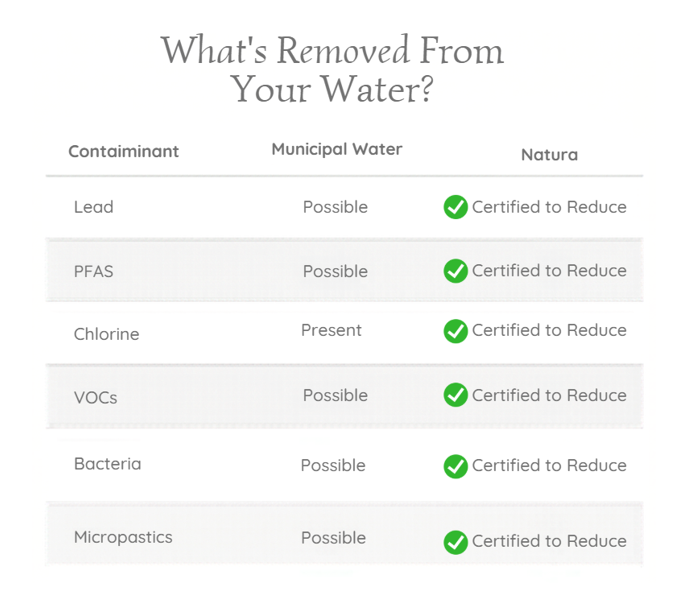
The reality is that even water that meets federal safety standards can contain a surprising number of contaminants. Lead from aging pipes. PFAS "forever chemicals." Microplastics. Chlorine byproducts. Volatile organic compounds.
Even bacteria and other microorganisms.
Meeting regulatory standards means water is considered safe to drink. It doesn't necessarily mean it's as clean as it could be.
That's why Natura Water was built around a simple belief: your water should do more than meet the minimum standard.
The Problem with "Good Enough"
The Safe Drinking Water Act was created to establish a baseline for public safety, and municipal water systems do an incredible job serving millions of people every day. But those systems were designed for large-scale distribution, not for optimizing water quality at the individual level.
How Natura Filters It Out
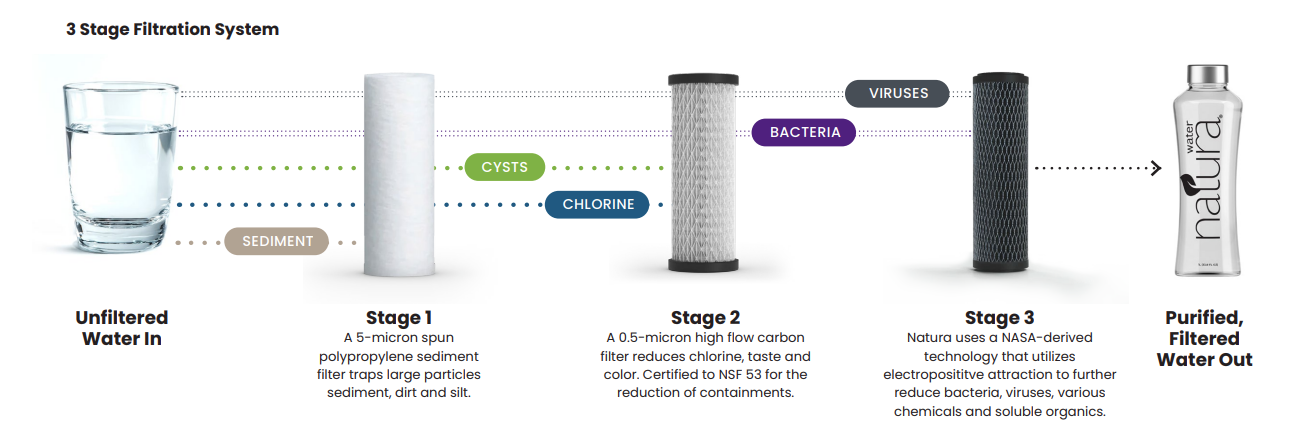
Natura uses a proprietary three-stage purification process designed to address both regulated contaminants and many of the emerging substances that regulations haven't fully caught up with yet.
Stage 1: Sediment Filtration
The process starts with an NSF-certified sediment filter that removes particles 5 microns and larger, including:
- Rust and pipe scale
- Dirt, sand, and silt
- Biological debris
This first layer helps improve clarity while protecting the rest of the filtration system, helping it perform consistently over time.
Stage 2: Carbon Filtration (NSF/ANSI Standard 53 Certified)
Next, water passes through advanced activated carbon filtration certified to
NSF/ANSI Standard 53, one of the industry's leading standards for health-related contaminant reduction.
This stage targets:
- Chlorine and chloramine compounds
- Lead
- PFAS chemicals
- VOCs
- Organic contaminants and odors
This is also where most people notice the biggest difference.
Removing chlorine and chemical compounds doesn't just improve water quality—it dramatically improves taste. And when water tastes better, people naturally tend to drink more of it. Better hydration is one of the simplest ways to support overall health, energy, and daily performance.
Stage 3: NASA-Derived NanoCeram® Filtration
The final stage is where Natura truly separates itself from conventional filtration systems.
Our electropositive NanoCeram® technology, originally developed for NASA applications, captures contaminants as small as 0.2 microns and is engineered to reduce:
- Bacteria and microorganisms
- Cysts
- Endotoxins
- Other submicron contaminants
NanoCeram® technology can remove up to 99.95% of endotoxins, delivering a level of purification that most standard filtration systems simply aren't built to achieve.
The result is water that is cleaner, safer, and easier to trust with every glass.
And bottled water isn't always the answer either. Recent testing by Consumer Reports found measurable levels of PFAS in several popular bottled water brands.
Some of the most common contaminants found in drinking water today include:
- Lead — often introduced through aging plumbing and corroded pipes. According to the CDC, no level of lead exposure is considered safe for children.
- PFAS ("forever chemicals") — persistent compounds found in municipal water systems, bottled water, and even sparkling water products.
- Chlorine and chloramine byproducts — commonly used in water treatment but known to affect taste and contribute to the formation of trihalomethanes (THMs).
- Volatile Organic Compounds (VOCs) — contaminants that can enter water supplies through industrial and agricultural runoff.
- Microplastics — increasingly detected in both tap and bottled water.
- Bacteria and microorganisms — including cysts and endotoxins that many basic filtration systems are not designed to remove.
The takeaway is simple: regardless of where your water comes from, there's a good chance it could be cleaner.
Why Cleaner Water Matters
Water quality affects far more than taste.
Research from the
Mayo Clinic and
Harvard Medical School continues to show that proper hydration plays a critical role in:
- Energy levels and mental focus
- Cognitive performance and concentration
- Digestive health and nutrient absorption
- Cellular function and nutrient transport
- Temperature regulation and physical performance
Natura supports hydration in two important ways.
First, it removes contaminants that negatively affect taste, making water more enjoyable to drink. Second, it helps reduce ongoing exposure to contaminants such as lead,
PFAS, chlorine byproducts, and microorganisms.
In other words, every glass delivers hydration without the unnecessary extras.
Built for Every Environment
Natura systems are designed for both residential and commercial settings where water quality directly impacts health, experience, and operations.
Homes
Families gain added protection from common drinking water contaminants while enjoying cleaner, better-tasting water throughout the home.
Offices
Hydration has a direct impact on focus, productivity, and overall well-being. Natura eliminates the cost, waste, and inconvenience of bottled water programs while providing a premium drinking experience.
Restaurants
Water influences the flavor of everything it touches—from coffee and tea to cocktails, soups, and sauces. By removing chlorine and unwanted compounds, Natura helps elevate both food and beverage quality.
Hotels
Today's guests increasingly value wellness and sustainability. Natura supports both by reducing reliance on single-use plastics while delivering a premium hydration experience that aligns with modern hospitality standards.
The Bottom Line
Your water should support your health—not work against it.
Natura's advanced triple-filtration system is designed to reduce chlorine, lead, PFAS, VOCs, microplastics, bacteria, and other unwanted contaminants while preserving the clean, refreshing taste people love.
The difference isn't just something you can taste. It's something you can feel over time.
Cleaner water isn't a luxury. It's something every person deserves.
Ready to experience the Natura difference?
Click here to schedule a consultation today and discover the right solution for your home, office, restaurant, or hotel.
Why should I filter my drinking water if my tap water is already considered safe?
Municipal water is treated to meet federal safety standards, but "safe" doesn't always mean contaminant-free. Water can still contain substances like lead, PFAS, chlorine byproducts, microplastics, and other contaminants that may affect taste, odor, and overall water quality. A high-quality filtration system provides an added layer of protection.
What contaminants does the Natura Water filtration system reduce?
Natura's three-stage filtration system is designed to reduce a wide range of contaminants, including:
Lead
PFAS ("forever chemicals")
Chlorine and chloramine compounds
Volatile Organic Compounds (VOCs)
Sediment, dirt, rust, and silt
Microorganisms, bacteria, and cysts
Endotoxins
Other submicron contaminants
What makes Natura different from standard water filters?
Most basic filters focus primarily on improving taste by reducing chlorine. Natura combines sediment filtration, NSF/ANSI Standard 53-certified activated carbon filtration, and NASA-derived NanoCeram® technology to target both common and emerging contaminants—including bacteria and endotoxins that many traditional filters aren't designed to address.
What is NanoCeram® technology?
NanoCeram® is an advanced electropositive filtration media originally developed for NASA applications. It captures contaminants as small as 0.2 microns and is engineered to reduce bacteria, cysts, endotoxins, and other microscopic contaminants that conventional carbon filters may miss.
Does Natura remove PFAS ("forever chemicals")?
Yes. Natura's activated carbon filtration stage is designed to reduce PFAS compounds, which have become an increasing concern in both municipal and bottled water supplies.
Will filtered water taste better?
Absolutely. By reducing chlorine, chloramine compounds, and other impurities that affect flavor and odor, Natura delivers cleaner, fresher-tasting water that many people find more enjoyable to drink.
Does better-tasting water help me stay hydrated?
It can. When water tastes better, many people naturally drink more of it. Proper hydration supports energy levels, focus, digestion, physical performance, and overall wellness.
Does Natura remove lead from drinking water?
Yes. Natura's NSF/ANSI Standard 53-certified carbon filtration is designed to reduce lead, helping minimize exposure to one of the most concerning contaminants that can enter drinking water through aging plumbing.
Title or Question
Describe the item or answer the question so that site visitors who are interested get more information. You can emphasize this text with bullets, italics or bold, and add links.Can Natura remove bacteria and microorganisms?
Yes. The final NanoCeram® filtration stage is engineered to reduce bacteria, microorganisms, cysts, and endotoxins for an additional level of purification.
Does Natura remove microplastics?
Natura's multi-stage filtration system is designed to reduce many particulate contaminants, including microplastics commonly found in today's drinking water.
Is bottled water cleaner than filtered water?
Not necessarily. Studies have found that some bottled water brands contain PFAS, microplastics, and other contaminants. High-quality filtration can provide clean, great-tasting water while reducing plastic waste and the ongoing cost of bottled water..
What certifications does the Natura filtration system have?
Natura uses NSF-certified filtration components, including an NSF/ANSI Standard 53-certified carbon filter designed for health-related contaminant reduction.
Is Natura only for homes?
No. Natura systems are designed for a variety of environments, including:
Homes
Offices
Restaurants
Hotels
Commercial facilities
Anywhere clean, great-tasting water is important, Natura can provide a reliable solution.
Why is chlorine added to drinking water?
Municipal water systems use chlorine and chloramine to disinfect water and control bacteria during distribution. While effective for public health, these compounds can negatively affect taste and may contribute to the formation of disinfection byproducts.
Does filtering water remove healthy minerals?
Natura is designed to reduce unwanted contaminants while preserving the clean, refreshing taste of drinking water. Unlike some purification methods that strip virtually everything from water, Natura focuses on targeted contaminant reduction.
How does Natura compare to a basic carbon pitcher filter?
While pitcher filters primarily improve taste by reducing chlorine, Natura's three-stage system provides more comprehensive filtration by addressing sediment, lead, PFAS, VOCs, bacteria, cysts, endotoxins, and other microscopic contaminants.
Why is cleaner water important?
Cleaner water supports healthier hydration by reducing ongoing exposure to contaminants while encouraging people to drink more water. Proper hydration plays an important role in energy, cognitive function, digestion, temperature regulation, and overall wellness.
How can I learn more about Natura Water?
If you're interested in improving the quality of your drinking water, contact Natura Water to schedule a consultation. Our team can help you find the right filtration solution for your home, office, restaurant, or hotel.
Recent Posts