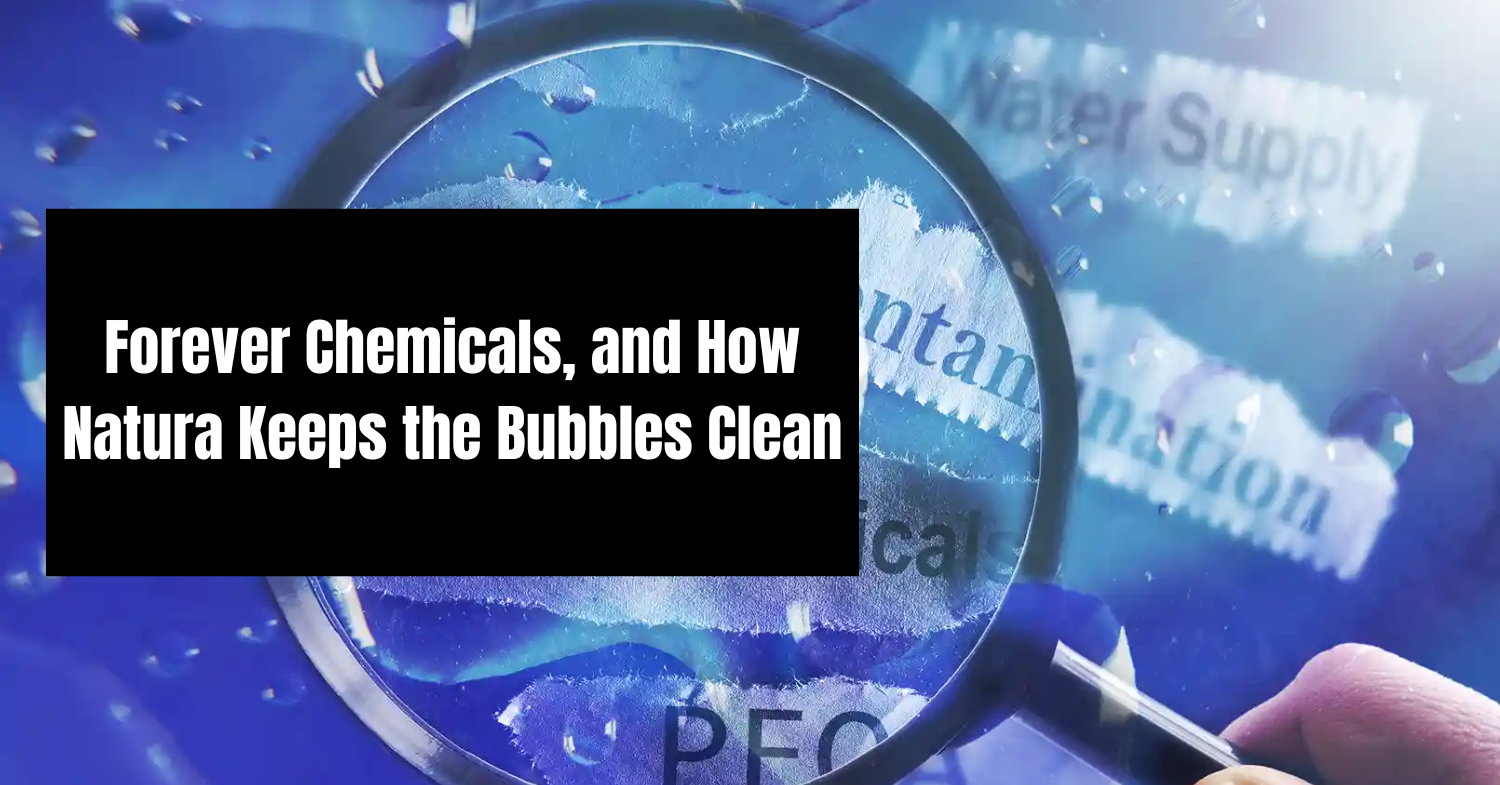
Forever Chemicals, and How Natura Keeps the Bubbles Clean
If you’re like many of our guests and customers, you’ve swapped sugary sodas for sparkling water and never looked back. The bubbles feel light, refreshing, and—on the surface—like the smarter choice.
But there’s a growing concern hiding inside some cans and bottles: “forever chemicals,” also known as PFAS (per- and polyfluoroalkyl substances). These man-made chemicals don’t break down easily in the environment or the human body and are now being detected in tap water, bottled water, and yes—sparkling water. NSF+1
“How do I keep the sparkling water experience but get rid of the forever chemicals?”
Let’s walk through what’s really going on with PFAS in sparkling water, and how Natura’s ANSI-53 spec’d filtration is engineered to strip these contaminants out before your water is chilled and carbonated.
What are “forever chemicals” and why are they in sparkling water?
PFAS are a large family of chemicals, tens of thousands of them, used since the 1940s to make products water-, oil-, and stain-resistant (think non-stick pans, food packaging, waterproof jackets, firefighting foam, and more). NSF+1
Because PFAS don’t break down easily, they build up in soil and water, eventually entering rivers, reservoirs, and aquifers that supply our drinking water. From there, they can end up in:
- Municipal tap water
- Private wells
- Bottled still and sparkling water
A 2020 Consumer Reports investigation of 47 bottled waters (including 12 carbonated products) found detectable PFAS in many brands, with several popular sparkling waters showing levels that concerned independent experts. Consumer Reports+2Consumer Reports+2
A recent Health.com review of the evidence highlighted that well-known sparkling water brands including Topo Chico, Polar, LaCroix, and others tested positive for PFAS, with some products measuring multiple parts per trillion (ppt). Health+1
The health concerns behind the headlines
Regulators and health agencies are taking PFAS seriously—and for good reason. Studies and public-health reviews have linked long-term PFAS exposure to:
- Certain cancers
- Liver damage and altered liver enzymes
- Immune system effects (including reduced vaccine response)
- Thyroid disruption
- Developmental effects in fetuses and infants, and pregnancy complications NSF+1
In April 2024, the U.S. EPA issued the first legally enforceable national drinking water standards for several PFAS, setting maximum contaminant levels as low as 4 ppt for PFOA and PFOS essentially near the limits of detection. NSF+1
In other words: the scientific and regulatory communities now agree that even very small amounts of these chemicals matter.
How PFAS get into sparkling water
Even when a sparkling water brand looks “clean” on the label, PFAS can sneak in through:
- Source water contamination – If the spring or municipal source has PFAS, they can carry through into the final product. Sensorex Liquid Analysis Technology+1
- Inadequate treatment – Not all bottlers use advanced filtration. Simple sediment or basic carbon filters may improve taste but don’t reliably remove PFAS. Sensorex Liquid Analysis Technology+1
- Processing and infrastructure – Equipment, piping, and packaging materials can contribute trace contaminants over time. Health+1
That’s why independent studies have found PFAS levels ranging from non-detect up to nearly 10 ppt in various sparkling waters. PFAS Central+1
You can’t see it, smell it, or taste it—and the label doesn’t tell you it’s there.
Why point-of-use filtration is your strongest defense
Here’s the good news: PFAS can be removed from water using the right technology.
The U.S. EPA and NSF International both point to filters that are independently certified to NSF/ANSI Standard 53 (or 58, for reverse osmosis) specifically for PFAS reduction as one of the most effective ways to lower PFAS in drinking water. NSF+1
To carry a PFAS reduction claim under NSF/ANSI 53, a filter must cut PFAS levels to below 20 ppt—and certified products are periodically retested and audited to ensure they continue to perform. NSF+1
That’s the standard we build around at Natura.
How Natura’s ANSI-53 spec’d filtration targets “forever chemicals”
At Natura Water, our systems use an ANSI-53 spec’d three-stage filtration train designed for health-critical contaminants—not just taste. Natura Water+1
Here’s how those stages work together before your water is chilled and carbonated:
- Stage I – Sediment & pre-filtration
An NSF-certified sediment filter removes larger particles (like rust, sand, and silt), protecting downstream filters and ensuring consistent flow. Natura Water - Stage II – NSF/ANSI 53-certified carbon block
This is the workhorse for PFAS and many other toxins. High-performance activated carbon is engineered to adsorb organic contaminants, including PFAS compounds like PFOA and PFOS, as well as chlorine byproducts, VOCs, and off-tastes. Under NSF/ANSI 53, activated-carbon filters can be specifically tested and certified for PFAS reduction down to stringent thresholds. NSF+1 - Stage III – Electropositive nanoceram polishing
A nanoceramic filter (derived from NASA technology) provides 0.2-micron filtration and strong electropositive attraction, capturing remaining microscopic particles and charged contaminants. In Natura’s PFAS-targeting configuration, this acts as a final “safety net,” complementing the carbon block’s chemical adsorption. Natura Water+1
Together, these stages are engineered to dramatically reduce PFAS and other toxic compounds in the water feeding your Natura still and sparkling taps—so the only thing your guests notice is ultra-clean, crisp water and fine, restaurant-grade bubbles.
Why this matters for sparkling water specifically
Sparkling water is often consumed in high volumes—by employees at refill stations, guests at a restaurant table, or families at home. Studies show carbonated waters are more likely to contain detectable PFAS than many still bottled waters. Consumer Reports+1
That means every glass of sparkling water is a repeat exposure opportunity. When you run that water through a PFAS-reducing, NSF/ANSI 53-based system like Natura before carbonation:
- You control PFAS at the source your own tap
- You avoid the uncertainty of anonymous bottling lines and changing water sources
- You dramatically cut down single-use plastic and glass waste at the same time
For restaurants and hotels, that’s a powerful combination: better health protection, better sustainability story, and a better guest experience. For homes and offices, it’s peace of mind in every pour.
The bottom line: Keep the bubbles, lose the forever chemicals
PFAS in sparkling water isn’t about panic it’s about awareness and control. The science is clear that these “forever chemicals” are toxic at very low levels and increasingly regulated. NSF+2NSF+2
By choosing a system built around ANSI-53 spec’d filtration—like Natura—you’re taking the same approach experts recommend: independent certification, advanced carbon and nanoceramic technology, and performance verified against strict PFAS reduction criteria. Natura Water+2NSF+2
So you don’t have to give up the sparkling water ritual your team and guests love.
You simply upgrade what’s behind the bubbles.
If you’d like to see how a Natura system could help protect your home, restaurant, or workplace from PFAS while delivering premium still and sparkling water on demand, our team is here to help you design the right solution.
Discover the difference. Choose Natura.
Want to learn how a Natura system can work for you? Click here here to schedule a meeting!
Recent Posts